


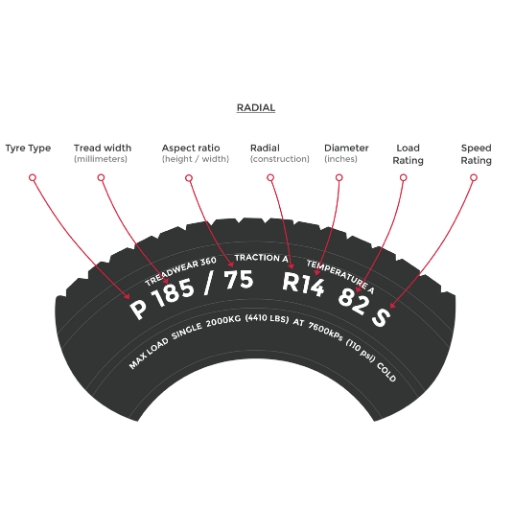
Your tyre size plays a big part in how your car drives, stops, and stays safe on the road. It affects your fuel use, handling, and even how comfortable your ride feels. Picking the wrong size can change how your car grips corners or passes an MOT. In this guide, you’ll learn how to find your car’s correct tyre size quickly, understand what each number and letter means, and get simple tips if you’re thinking about changing wheel size or upgrading. Let’s make tyre sizes easy to understand once and for all.
Where You Can Find Your Tyre Size in Seconds
Finding your tyre size doesn’t take long once you know where to look. Most cars show it in a few easy-to-spot places.
- Check the door jamb or B-pillar sticker: Open the driver’s side door and look near the hinge or on the door frame. You’ll see a sticker showing tyre sizes, pressure settings, and sometimes load information. It usually lists sizes for both front and rear tyres.
- Look under the fuel flap or inside the glovebox: Some cars include the same sticker inside the fuel flap or glovebox. These spots often list the correct tyre pressure and size based on your car’s trim level or weight.
- Read the sidewall of your current tyres: You can also find your tyre size printed on the side of the tyre, written like 205/55 R16 91V. This tells you width, aspect ratio, rim size, and speed rating. Be careful if your car already has non-original wheels, as that size might not match the factory recommendation.
- Use online tools or your car’s VIN number: If you’re unsure, check your car’s handbook or enter your registration or VIN into tyre brand fitment tools online. They’ll show the manufacturer-approved sizes that fit your car perfectly.
How to Read a Tyre Sidewall Code (Example: 205/55 R16 91V)
Every tyre has a code on its sidewall that looks like a mix of numbers and letters, such as 205/55 R16 91V. Once you understand what each part means, you can pick the right tyres with confidence.
- 205: This is the tyre’s width in millimetres, measured from side to side.
- 55: This is the aspect ratio, meaning the tyre’s height is 55% of its width.
- R: This stands for radial construction, which is the most common type of tyre today.
- 16: This is the wheel’s diameter in inches. Your new tyres must match this size exactly.
- 91: This is the load index, showing how much weight each tyre can safely carry.
- V: This is the speed rating, which tells you the maximum speed the tyre can handle safely.
Here’s a quick guide for load and speed ratings:
Load Index | Max Load (per tyre) | Speed Rating | Max Speed |
88 | 560 kg | T | 118 mph (190 km/h) |
91 | 615 kg | H | 130 mph (210 km/h) |
94 | 670 kg | V | 149 mph (240 km/h) |
97 | 730 kg | W | 168 mph (270 km/h) |
100 | 800 kg | Y | 186 mph (300 km/h) |
Once you read these markings, you’ll know exactly which tyres match your car’s needs for weight, speed, and fitment
Tyre Size vs Wheel Size: What Actually Fits Your Car
Your tyres and wheels must work together as a perfect match. A tyre that’s too wide or too narrow for your rim can affect grip, steering, and wear. The goal is to keep everything within the safe range set by your car manufacturer.
Rim Width (inches) | Recommended Tyre Width Range (mm) |
5.5” | 165–185 mm |
6.0” | 175–195 mm |
6.5” | 185–205 mm |
7.0” | 195–215 mm |
7.5” | 205–225 mm |
8.0” | 215–235 mm |
Staying within this range keeps the sidewalls firm and helps the tyre seat correctly on the rim.
Offset (ET), centre bore, and PCD
The offset (ET) is how far the wheel’s mounting face sits from its centre line. A big change in offset can make the wheel stick out too far or sit too deep, affecting handling and suspension wear. The centre bore is the hole that fits over your car’s hub. It needs to match perfectly for smooth rotation. The PCD (Pitch Circle Diameter) refers to the number of bolt holes and the distance between them (for example, 5×112). Using the wrong PCD can stop the wheel from fitting properly.
Plus-Sizing and Down-Sizing Without Problems
Changing tyre or wheel size can improve your car’s look or handling, but it must be done correctly. The most important rule is to keep the overall diameter within ±2% of the original size. This small limit protects your ABS, traction control, ESC, and speedometer from being thrown off.
How to calculate overall diameter
You can find the diameter using this simple formula:
Tyre diameter = (tyre width × aspect ratio × 2 ÷ 25.4) + rim diameter
Example: for a 205/55 R16 tyre
= (205 × 0.55 × 2 ÷ 25.4) + 16
= 24.9 inches (about 633 mm).
Use this to check if your new size stays close to the original.
Speedometer change example
If you fit tyres with a diameter 3% larger, your speedometer will show 60 mph when you’re actually doing around 62 mph. A smaller tyre will have the opposite effect. Staying within that ±2% range keeps readings accurate.
Safe upgrade paths
Here are a few examples of safe size swaps:
Original Size | Possible Upgrade | Difference |
195/65 R15 | 205/55 R16 | +1.6% |
205/55 R16 | 225/45 R17 | +1.3% |
225/45 R17 | 235/40 R18 | +1.5% |
215/60 R16 | 225/50 R17 | -1.9% |
Keeping the overall diameter close helps your car drive as intended. Plus-sizing can improve cornering and style, while down-sizing can give better comfort and cheaper winter options, as long as you stay inside the safe range.
Load Index: Pick the Right Strength for Your Vehicle
The load index tells you how much weight each tyre can safely carry. You’ll find it in the tyre size code, such as the 91 in 205/55 R16 91V. Always match or go higher than the load index listed on your car’s tyre placard or in the handbook. Using a lower rating can make the tyres overheat and fail under pressure.
When to use XL or reinforced tyres
If you drive an SUV, MPV, van, or electric car, you may need XL (Extra Load) or Reinforced tyres. These tyres have stronger sidewalls to handle the extra weight and torque. EVs, for example, are heavier and can wear standard tyres faster, so reinforced ones last longer and stay stable during acceleration.
Risks of using the wrong load index
Fitting tyres with a lower index can lead to heat build-up, blowouts, and faster wear. It can also cause insurance issues if an accident happens and the tyres don’t meet your car’s legal or safety standards. Always check the load index before buying tyres. It keeps your car safe, your insurance valid, and your tyres performing as they should.
Speed Rating: Match Performance to Real-World Driving
The speed rating shows the maximum speed a tyre can handle safely when carrying its full load. You’ll find it at the end of your tyre size code, such as the V in 205/55 R16 91V. Picking the right rating keeps your tyres stable and your handling consistent at higher speeds.
Here’s a quick guide to popular ratings:
Rating | Max Speed (mph) | Max Speed (km/h) |
T | 118 | 190 |
H | 130 | 210 |
V | 149 | 240 |
W | 168 | 270 |
Y | 186 | 300 |
In the UK and EU, tyres must meet or exceed the original speed rating listed by the vehicle manufacturer. Lower-rated tyres can cause MOT issues and may affect your insurance if fitted incorrectly.
Winter tyres often show a lower speed rating than your standard summer tyres. That’s normal because they’re made with softer rubber that focuses on grip rather than top speed. As long as the rating meets or exceeds the minimum required for your car, they’re safe and legal to use during colder months.
SUV, 4×4, and Van Sizes: Understand LT, C, and All-Terrain Markings on Tyres
If you drive an SUV, 4×4, or van, your tyre markings can look a little different. These vehicles carry more weight or face tougher road conditions, so their tyres are built stronger.
1- LT and C markings
The LT (Light Truck) marking means the tyre is designed for heavier loads and off-road use. The C (Commercial) marking is common on vans and means the tyre has a reinforced structure with extra plies for strength. You might also see Load Range or Ply Rating, such as 6PR or 8PR, showing how much pressure and weight the tyre can handle.
2- All-terrain vs highway tread
If you drive on both roads and rough tracks, All-Terrain (A/T) tyres are a good match. They have deeper tread blocks for grip on gravel and mud but are noisier on smooth roads. Highway (H/T) tyres are smoother, quieter, and more fuel-efficient but don’t handle off-road conditions as well.
3- Towing and payload needs
When towing or carrying heavy loads, tyre strength matters. Always choose a load index that matches your vehicle’s gross weight and towing limits. Under-rated tyres can overheat and fail, especially on long motorway runs.
Picking the right tyre type and rating keeps your SUV, van, or 4×4 steady, safe, and ready for both city roads and rougher routes.
All-Season, Summer, and Winter in Your Size
Most common tyre sizes in the UK are now available in all three types, summer, winter, and all-season. You can even find many all-season tyres with the 3PMSF (Three-Peak Mountain Snowflake) symbol, which proves they’ve passed winter traction tests. If your size has a 3PMSF option, it’s a great choice for year-round safety without needing seasonal swaps.
The UK’s weather changes quickly, with cold rain, wet leaves, and mild winters. Always check wet grip ratings when comparing tyres. A tyre rated “A” for wet grip stops much faster than one rated “C” or lower, which makes a big difference on slippery roads.
If you drive in colder or rural areas, downsizing your winter wheels can save money and add strength. Smaller rims with taller tyres handle potholes better and cost less per set. Just keep the overall diameter within ±2% of your standard size to stay safe and accurate.
Wrapping Up:
Knowing your tyre size gives you control over safety, comfort, and performance. You now understand where to find it, how to read it, and what the numbers and letters mean. Matching the right size keeps your car handling well, braking safely, and using fuel efficiently.
Before buying new tyres, always check the markings, load index, and speed rating that suit your vehicle. Picking the right size and type, summer, winter, or all-season, keeps your car ready for any UK road and every kind of weather.